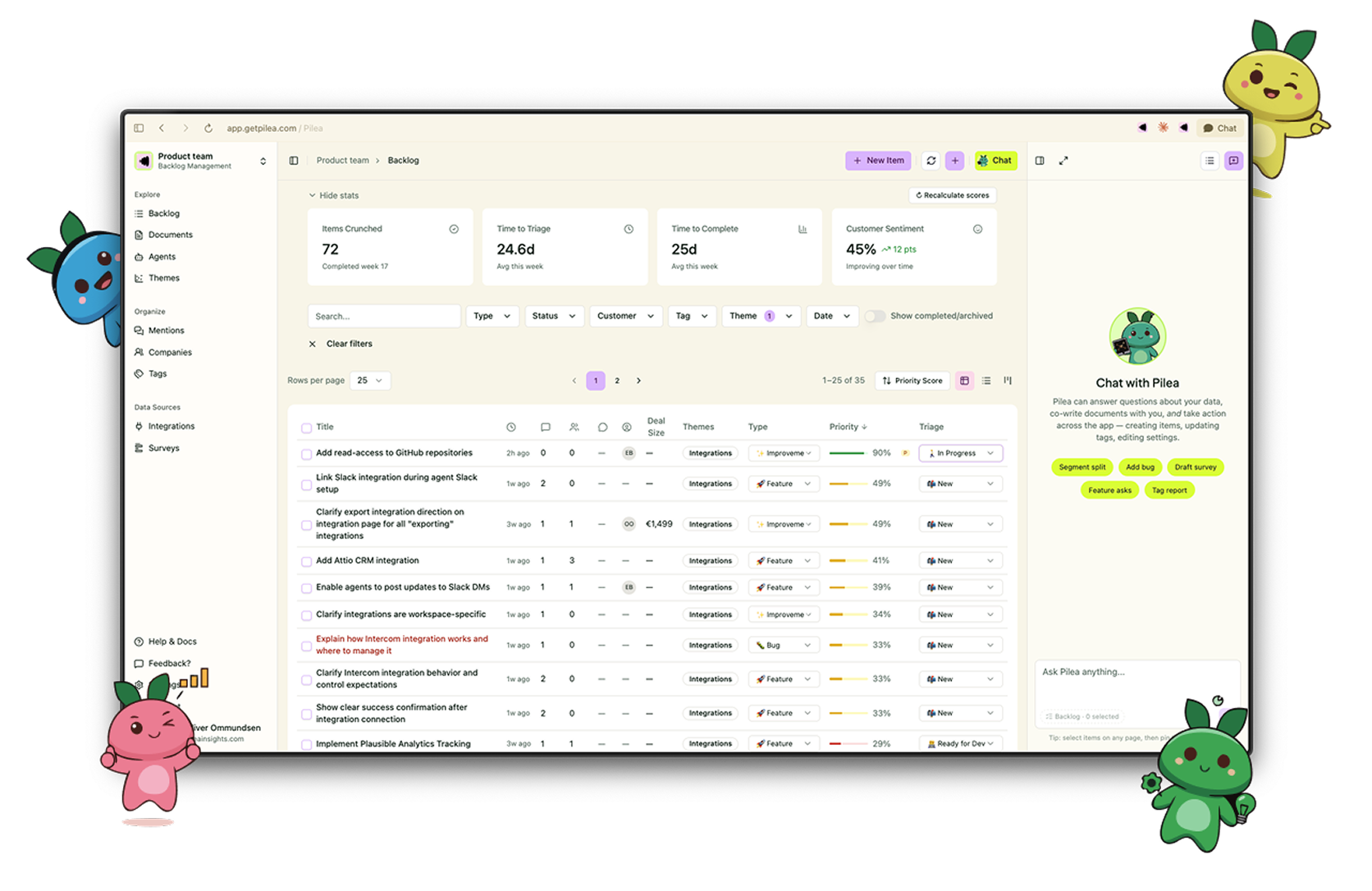
Pilea now includes autonomous agents – specialised AI teammates that continuously turn raw customer signals into prioritised, actionable product work. In this update, we’re introducing agents and highlighting two core agents you can start with today.
Pilea now includes agents that continuously turn raw customer signals into prioritised, actionable product work.
In this update, we’re introducing agents as a standalone concept and highlighting three core agents you can start with today:
Pilea 🌱 – your orchestrator agent that keeps all your product AI teammates aligned, safe, and working to your strategy.
Basil 🚀 – your feedback & backlog gardener that keeps your product backlog clean, structured, and prioritised.
Lily 🔎 – your release notes and insight writer that turns completed work into clear, user-facing product updates and technical changelogs.
Why we’re introducing Pilea agents
As teams grow, keeping up with customer signals, translating them into the right product decisions and keeping your customer up to date becomes more than a full-time job.
Pilea agents are our answer to this.
They act like a lean product ops team in a box:
Continuously listening to customer signals
Maintaining a prioritised backlog
Telling the story of what you’ve shipped
All with clear audit trails and controls, so you stay in charge.
What are Pilea agents?
Pilea agents are specialised AI workers that you configure to own specific parts of your product operations.
Each agent:
Runs on a schedule (e.g. daily, weekly) or can be run on demand
Connects to your existing tools (Slack, HubSpot, Intercom, Notion, GitHub, and more)
Produces concrete artefacts: backlog items, prioritisation updates, insights, and reports
Delivers outcomes where your team already works (Slack, email, or inside Pilea)
You decide the job, inputs and outputs, simply through natural language.
Outcomes you can expect
Pilea agents are designed to improve how your team works, not just to add more automation.
1. Less time on triage, more time on strategy
50–80% less time spent manually tagging, merging, and grooming feedback
Backlog that reflects reality, without needing heroic cleanup sessions
2. Higher confidence in what to ship next
A single, prioritised view of bugs, feature requests, and improvements
Priority scores updated continuously as new signals come in
3. Faster response to customer pain
Critical issues surfaced quickly, with which customers and segments are affected
Clear linkage between feedback, revenue, and implementation status
4. Better shared understanding
Product, CS, and Engineering working from the same source of truth
Regular, readable summaries instead of scattered screenshots and links
Meet Pilea – always there to help
Pilea is your main boss!
What Pilea does
Shares general weekly updates about your customer signals
Creates and updates customers, backlog items, and feedback so your data stays structured
Helps tag, merge, and link feedback and backlog items so you keep a consistent taxonomy
Create new agents and skills in your workspace
Meet Basil – your backlog manager
Basil is the backlog manager who never sleeps!
What Basil does
Monitors new bugs and improvements and creates a detailed specification based on your codebase
Keeps a steady flow of prioritised tasks ready for development
Help avoid duplicate issues and stale tickets that no longer reflect the real issue
Outcomes with Basil
With Basil enabled, you get:
A backlog that mirrors actual customer pain and commercial impact
Continuous triage instead of quarterly backlog clean-up days
Higher signal-to-noise when deciding what to pick up next
Meet Lily – your product manager
Lily makes sure you keep your customers up to date with new releases!
What Lily does
Writes engaging product updates and changelogs from merged PRs from GitHub in your company's tone of voice
Continuously monitors your backlog and user research to find and suggest larger development initiatives
Keeps an eye on key customers' pain points through sales engagements
Gives your team a clean narrative: what changes, for whom, and why it matters
Outcomes with Lily
With Lily enabled, you get:
Consistent release communication without extra overhead
Clear stories around value and customer impact
Faster proof of progress to stakeholders and customers
What’s next
We’re already working on:
More preconfigured agent templates for common product workflows
Finer-grained controls over how assertive agents should be (from suggestions-only to more hands-on operations)
Deeper integration with your existing tools to reduce copy/paste and manual admin even further
We’d love your feedback
As always, we’d love to hear how agents fit into your workflow:
Which parts of your product operations feel the most repetitive today?
What would you like an agent to take off your plate next?
Just reply to this update or reach out to us in your usual channel – we read everything and use it to shape what we build.