
You know that moment when you think you understand why users do something, but you're not quite sure? Teresa Torres calls these assumptions. And she's right – they're everywhere in product development.
The problem? Most survey tools want you to send lengthy questionnaires that users ignore. Or worse, interrupt them with pop-ups that make them close your app faster than you can say "user feedback."
We designed Pilea Surveys differently.

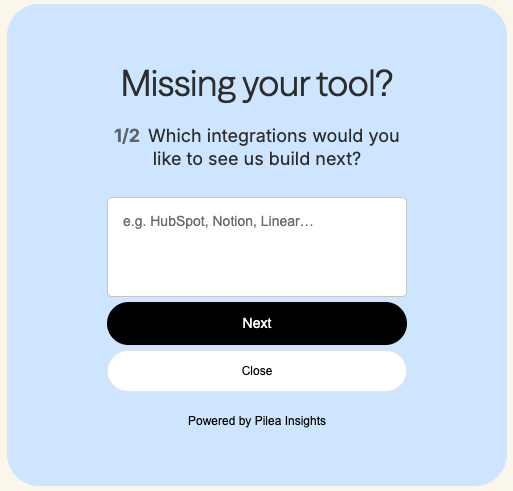
Pilea-surveys are short, targeted questions that appear within your product at specific moments. Unlike traditional survey tools that rely on email campaigns or disruptive pop-ups, Pilea-surveys capture feedback exactly when user intent is clearest.
Our surveys live right inside your product, exactly where the assumption exists. Spot someone using a feature you're curious about? Drop a quick question right there.
Why this works:
Users are 3-4x more likely to respond to in-context questions compared to email surveys because the experience is still fresh in their minds.
Teresa Torres, author of Continuous Discovery Habits and founder of ProductTalk, advocates for testing assumptions week by week, not quarter by quarter. That's exactly what we built for.
Practical examples of continuous validation:
Quick questions. Real context. Actual answers.
Different assumptions need different approaches. Pilea Surveys adapt to your discovery needs:
You're in control. No rigid templates forcing you into boxes.
Torres argues that assumptions left untested become expensive mistakes. The numbers back this up – product teams spend an average of 6-8 weeks building features based on untested assumptions, only to see poor adoption rates.
With continuous validation, you can:
Ready to move from guessing to knowing? Here's how Pilea makes assumption testing simple:
Feedback chaos? We've got this. Small surveys, big clarity.
Ready to test your assumptions without annoying your users?
Start validating with Pilea Surveys – designed for product teams practicing continuous discovery.
Related: Learn more about continuous discovery habits, customer feedback management, and assumption testing for product managers.

